For decades, Pink built a career around proving she belonged in rooms where many people never expected to see her. From pop stardom to aerial performances that became a signature part of her live shows, she repeatedly challenged assumptions about what kind of artist she could be. At the 2026 Tony Awards, she faced a new version of that challenge when she stepped onto Broadway’s biggest stage as host of the ceremony.
The opening number immediately addressed the question many viewers had been asking. Suspended high above the audience in a tribute to Peter Pan, Pink joked about her own outsider status while showcasing the acrobatic skills that have defined her concerts for years. Former Tony Awards host Neil Patrick Harris interrupted the performance to playfully question why she was there, giving voice to the skepticism Pink herself acknowledged.
Rather than avoiding the issue, she embraced it. Throughout the opening sequence, Pink leaned into the idea that she had never actually performed on Broadway, despite her lifelong love of musical theater. She briefly moved through references to beloved productions including Phantom of the Opera, Les Misérables, and Wicked before Harris encouraged her to stop trying to fit into someone else’s definition of a Broadway star and simply be herself.
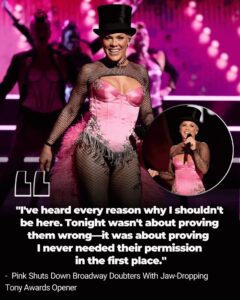
That advice became the theme of the night.
The performance soon exploded into a massive production titled “Leading Lady Marmalade,” a Broadway-inspired reimagining of the hit song that helped make Pink a household name more than two decades ago. Featuring more than 170 performers and appearances from stars including Megan Thee Stallion, Lea Michele, Dylan Mulvaney, and Shaina Taub, the number celebrated the creativity and diversity of contemporary theater while allowing Pink to bring her own personality to the event.
The standing ovation that followed was more than applause for a technically impressive performance. It was recognition that Pink had successfully bridged two different entertainment worlds. She was not pretending to be a Broadway veteran. Instead, she was bringing the qualities that made her successful elsewhere—fearlessness, humor, athleticism, and authenticity—to a new stage.
During her monologue, Pink continued to poke fun at herself while expressing genuine admiration for the theater community. She described herself as one of Broadway’s biggest fans and joked that her daughter Willow might actually deserve that title more than she did. The self-deprecating humor helped establish a connection with the audience while reinforcing that she understood the significance of the occasion.
The evening also allowed Pink to highlight issues that matter deeply to both the theater community and herself. Referencing several nominated productions, she spoke about division, social challenges, and support for transgender communities, emphasizing how theater often reflects the realities unfolding beyond the stage.
By the end of the ceremony’s opening moments, the question of why Pink was hosting had largely disappeared. The performance demonstrated that she did not need traditional Broadway credentials to connect with the audience. Instead, she succeeded by bringing her own voice, energy, and perspective to the role.
For Pink, the night became another chapter in a career built on refusing to let other people define where she belongs. Rather than seeking permission to stand on Broadway’s biggest stage, she simply stepped onto it and made it her own.
UDHËTO LIRË.
UDHËTO KOMOD.
Rezervo online shpejt, lehtë dhe pa stres.