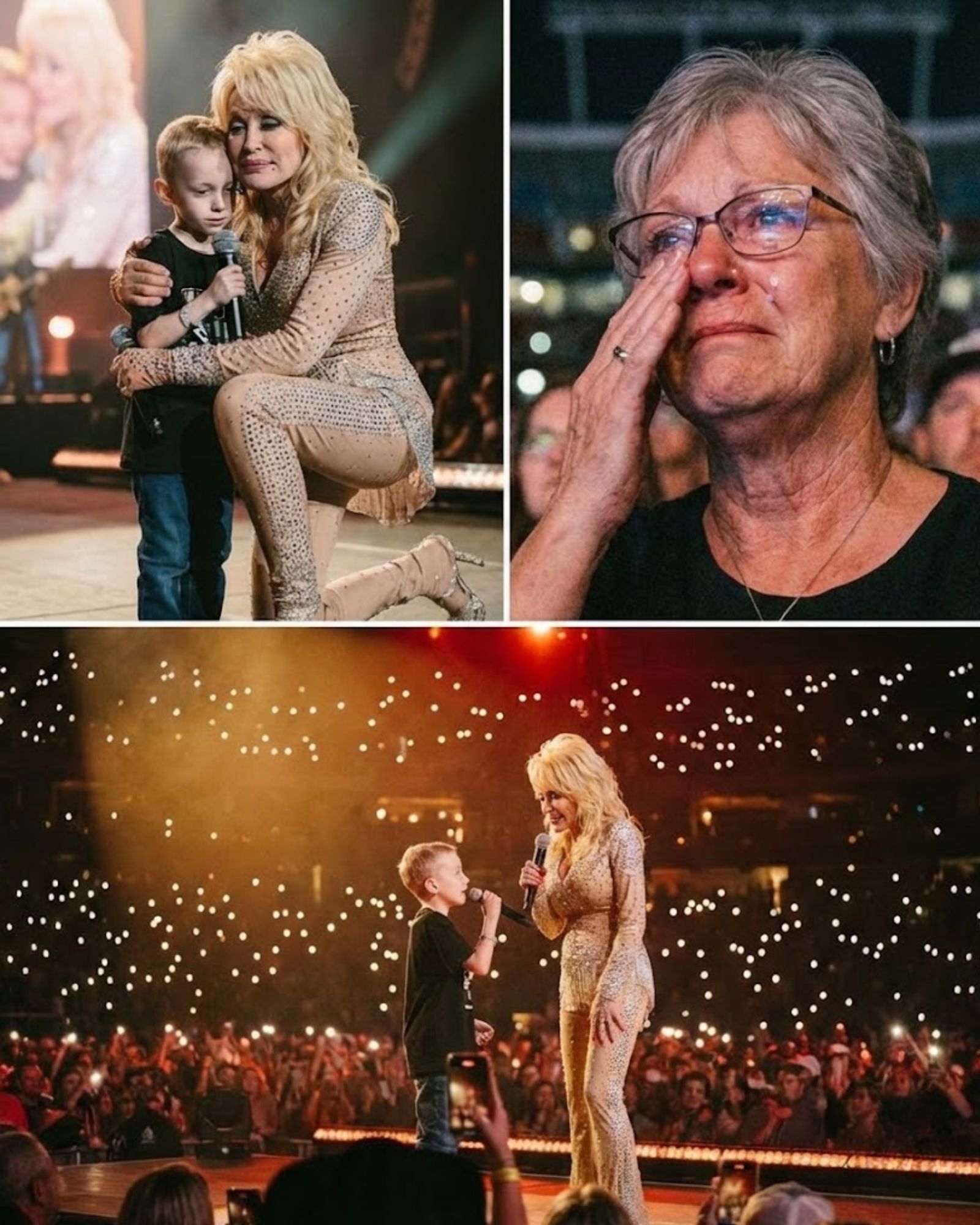
“AUNT DOLLY… CAN I SING WITH YOU JUST ONCE?” — AND 20,000 PEOPLE FORGOT HOW TO BREATHE. A 6-year-old boy stood at the edge of the stage. Small. Fragile. A heart support device pressed gently against his chest. He wasn’t asking for a miracle. He was waiting for a new heart. What he wanted that night was simpler. He looked up at Dolly Parton — 80 years old, a woman who has carried songs across more than six decades — and asked if he could sing with her. Just once. She could have smiled and waved. She could have let security handle it. Instead, Dolly set her rhinestone microphone aside. She walked over slowly. Knelt down. Face to face. Close enough to hear his shaky breath. “Tonight, sweetheart… this stage is yours.” No rehearsal. No key change discussion. Just one tiny voice beside a legend who has seen almost everything. And 20,000 people standing in silence, tears falling without apology. It wasn’t polished. It wasn’t perfect. But somehow… it felt bigger than any song she’s ever sung. And years from now, when people talk about Dolly Parton, they may not start with the awards or the records. They may start with the night she gave the stage away.

“Aunt Dolly… Can I Sing With You Just Once?” — The Night a Stadium Fell Silent

Some concerts are remembered for the fireworks. Others are remembered for the moment the room changes and nobody can explain why.

It started like any other big night. Bright lights. A packed venue. Thousands of voices warming up before the first note. The kind of crowd that comes ready to cheer, ready to sing, ready to forget the outside world for a few hours.

Then everything slowed down.

Near the edge of the stage, a little boy appeared. Six years old. Thin. Pale. Too small for the noise around him, like someone had placed a quiet question inside a place built for loud answers. A heart support device rested against his chest, held carefully in place. He wasn’t there to make a scene. He wasn’t there to be dramatic.

He was waiting for a new heart.

And somehow, in the middle of all that music, he asked for something else first.

A Question That Didn’t Sound Like a Request

When the microphone found him, his voice shook so badly it made the sound system feel fragile. He looked up at Dolly Parton like you look up at someone you trust without knowing why.

“Aunt Dolly… can I sing with you just once?”

It wasn’t a speech. It wasn’t rehearsed. It wasn’t framed as a plea for sympathy. It was the simplest kind of courage: a child asking for one small thing in a world that had already asked him for too much.

Dolly Parton was 80 years old. She had spent more than six decades standing under lights, balancing showmanship with heart, turning crowds into family without forcing it. She had seen every kind of moment a stage can offer. The planned ones. The chaotic ones. The ones that get smoothed out later in interviews.

This one didn’t come with a plan.

What Dolly Parton Did Next

She could have smiled, waved, and let the band carry the night forward. She could have offered a kind sentence and kept the show moving. There were a thousand “professional” ways to handle it.

Instead, Dolly Parton set her microphone down.

Not dramatically. Not for effect. Like it was the most natural thing in the world to pause an entire stadium for one small voice.

She walked to the edge of the stage and knelt until she was eye to eye with him. Close enough to hear his breathing. Close enough that the front rows could see her expression change from performer to something older and gentler.

Then Dolly Parton spoke softly, just loud enough to carry.

“Tonight, sweetheart… this stage belongs to you.”

There was no rehearsal. No whispered instructions. No insistence on perfection. Nobody asked what key he could sing in. Nobody tried to protect the moment from being “messy.”

The band waited. The lights stayed warm. And for a few seconds, 20,000 people forgot what they were supposed to do with their hands.

One Small Voice, One Lifetime of Music

When the boy started singing, it wasn’t polished. It wasn’t strong. It wasn’t built for a stadium.

But it was honest.

He leaned into the words like they were a place to rest. Dolly Parton didn’t overpower him. Dolly Parton didn’t turn it into a duet that proved anything. Dolly Parton simply stayed close, steady and patient, like a guardrail you don’t notice until you need it.

Somewhere in the crowd, people began to cry. Not the loud kind. The quiet kind you try to hide by clearing your throat. A few phones stayed down. A few people stared like they didn’t want to blink and miss it.

Because it wasn’t just a child singing.

It was a child, carrying a device against his chest, singing anyway.

It was Dolly Parton, eighty years into her own story, giving away the center of the stage as if that was the whole point of it.

And it was a stadium realizing that the best moments are rarely the ones you can recreate.

Why People Still Talk About It

Later, people would call it “the performance of a lifetime.” Not because it hit every note. Not because it was perfect. Because it was real in a way that can’t be manufactured.

It wasn’t about charts. It wasn’t about headlines. It wasn’t about proving Dolly Parton had a big heart. Dolly Parton didn’t need a moment like that to be admired.

What made it unforgettable was how quickly the power changed hands. One minute, a legend was holding a stadium. The next minute, a child was.

And Dolly Parton let it happen.

Some nights end with fireworks. Some nights end with an encore. But that night ended with something heavier and quieter: the feeling that everyone had witnessed a small, private miracle in public.

And even now, people still wonder what happened after the lights went down, after the last person left their seat, and after the boy stepped off the stage—because the kind of moment that stops 20,000 people cold never really feels finished.


Related Posts

“THE SONG THEY WROTE TOGETHER — SUNG IN FRONT OF 70,000 WITNESSES.” On June 7, 2025, at CMA Fest inside Nissan Stadium, the noise faded fast. Nearly 70,000 people held their breath as Miranda Lambert stepped into the light, silver dress catching every flicker. Her voice was quiet. Almost unsteady. “These words… are for you, Blake.” Blake Shelton stood in the front row with Carrie Underwood, Luke Bryan, and Kelsea Ballerini nearby. Hands clasped. Jaw tight. Eyes fixed on her. Then came “Over You.” A song born from shared grief. Different now. He didn’t look away when their eyes met. Cameras caught the tear he tried to hide. Some moments don’t end on stage. They linger — and this one left questions hanging in the air.

Scroll down to the end of the article to watch the performance. Miranda Lambert Delivers Emotional Performance of “Over You” at CMA Fest 2025 NASHVILLE, TN —…

Chock And Bates Walk Away From Disputed Gold As U.S. Figure Skating Stands Down

Team USA’s ice dancers appear to be moving on from the controversial scoring decision that seemingly snubbed them from a second gold medal at the 2026 Winter…

“WHEN A 73-YEAR-OLD LEGEND SAT SILENT… AND LET HIS BLOODLINE SING HIS LIFE BACK TO HIM.” Last night didn’t feel like a concert. It felt like a living room with 20,000 people holding their breath. Bubba Strait walked out first. Calm. Steady. Then little Harvey followed — small boots, big nerves. The opening chords of “I Cross My Heart” drifted through the arena. George Strait didn’t sing. He sat there. 73 years of highways, heartbreak, rodeos, and sold-out nights — and this time, he just listened. A son who knows the stories. A grandson who only knows the legend. No fireworks. No long speech. Just a family handing a man his own memories — one verse at a time. There was a pause near the end. George looked down. Smiled once. That quiet kind of smile that says everything. Some songs become classics. Others become inheritance. And for a few minutes… country music felt smaller. Softer. Personal.

When a 73-Year-Old Legend Sat Silent — And Let His Bloodline Sing His Life Back to Him It wasn’t the loudest moment of the night. There were…

Ilia Malinin Breaks Silence in Personal Video Address Responds to Online Hatred and Olympic Pressure

Figure skating star Ilia Malinin has released a deeply personal video addressing the intense reaction following his difficult Olympic performance a moment that became one of the most talked-about…

‘From fire and flags to a single spotlight’ — Kid Rock stuns with a reimagined take on “‘Til You Can’t” at Turning Point USA’s All-American Halftime Show, turning spectacle into statement

Kid Rock Performs New Version of “‘Til You Can’t” By Cody Johnson At Turning Point USA’s All-American Halftime Show Turning Point USA’s All-American Halftime Show also featured…

“WHEN THE EAGLE FINALLY TOOK FLIGHT, THE STADIUM WENT SILENT.” — BUDWEISER MARKS 150 YEARS WITH A CINEMATIC SUPER BOWL LX MASTERPIECE TITLED “AMERICAN ICONS.” In a game night built for spectacle, explosions, and celebrity overload, Budweiser chose something far more powerful — restraint. Dropped during Super Bowl LX in Santa Clara, the minute-long film opens with a vulnerable Clydesdale foal discovering a fallen eaglet, setting the stage for a story that unfolds across seasons, struggles, and quiet moments of growth. Directed by Henry-Alex Rubin and set to the soaring anthem Free Bird by Lynyrd Skynyrd, the ad builds slowly — no forced speeches, no overproduced sentiment — just two American symbols rising together. By the final frame, the fully grown bald eagle circles high above the now-mighty Clydesdale, locking in a breathtaking image of unity, resilience, and legacy that feels bigger than advertising. As fireworks lit up the stadium, it wasn’t noise people remembered — it was that soaring silhouette against the sky, a tribute to 150 years of storytelling that didn’t just sell beer, it claimed the emotional center of the night…

Bald Eagle and Clydesdale Horse Share Epic Friendship in Budweiser’s 2026 Super Bowl Commercial Budweiser is celebrating 150 years of making beer in the U.S. by featuring…