A Farewell the World Will Never Forget: Neil Diamond, Barbra Streisand, and Barry Manilow on One Unrepeatable Night
The arena lights were already up, the stage was ready, and the crowd was loud in that familiar pre-show way—people talking over each other, laughing, pointing toward the curtains like they could will the night to start faster. But the moment the movement began at stage left, the noise faded like someone turned down the volume on the entire building.
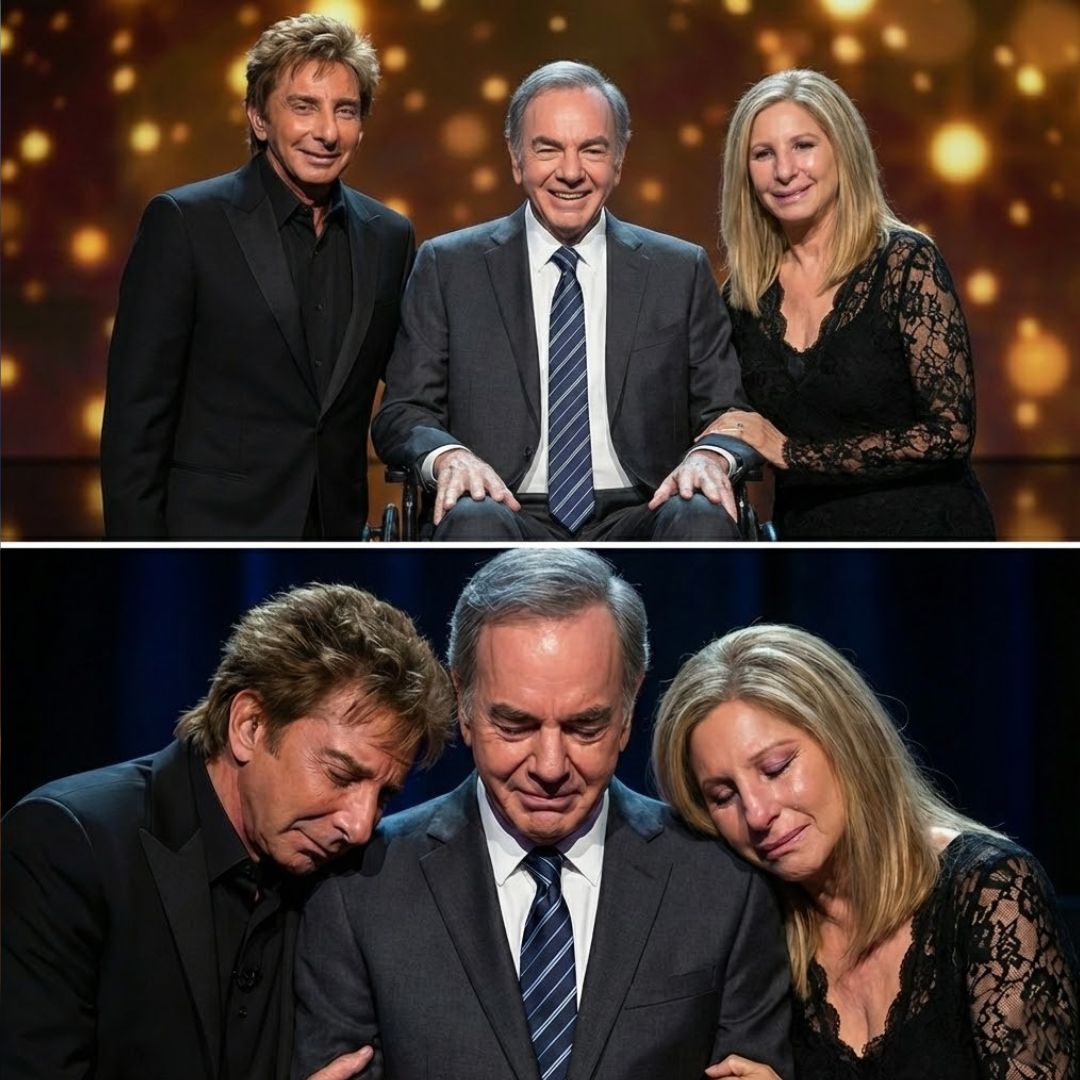
They wheeled Neil Diamond out slowly. Not with drama, not with a grand entrance, just carefully—like everyone understood that rushing would break something important. Under the warm spotlight, Neil Diamond looked smaller than the legend people carried in their heads. And yet there was a steadiness in his face that made the audience lean forward. This was not a man trying to prove anything. This was a man showing up.
He was not alone.
Barbra Streisand walked beside Neil Diamond and reached for his hand as if it was the most natural thing in the world. Not a show of support for cameras. Not an award-show pose. Just a simple hold—firm, quiet, human. Behind them, Barry Manilow moved into position at the piano. He sat down slowly, adjusted the bench, placed his hands above the keys, and then paused. His eyes were already wet, and he didn’t try to hide it.
The Silence Before the First Note
In big venues, silence is rare. Even during emotional moments, there’s usually a cough, a whisper, a phone screen lighting up. But this was different. The room didn’t simply become quiet. It became attentive. People could feel they were about to witness something that wasn’t going to happen again.
Barry Manilow let out a breath, looked toward Neil Diamond and Barbra Streisand, and then began the opening of You Don’t Bring Me Flowers. The first chords carried across the arena like a memory you didn’t realize you still had. Barbra Streisand lifted her mic and sang with that unmistakable clarity—clean, steady, and controlled in a way that somehow made it more emotional, not less.
Then Neil Diamond joined.
His voice wasn’t trying to be what it used to be. It was worn, honest, and close to the bone. And that’s what made it land. Because the song isn’t about volume or power. It’s about distance. It’s about the ache of what’s missing. Hearing Neil Diamond sing those lines while Barbra Streisand stood right there beside him made the whole thing feel less like a duet and more like a confession shared in public.
Not a Performance, Something Else
People often use big words when legends share a stage. “Iconic.” “Historic.” “Unforgettable.” But in the arena that night, nobody was reaching for fancy language. They were simply reacting. One person put a hand over their mouth. Another sat down hard like their knees suddenly gave out. Couples looked at each other and didn’t know what to say.
Halfway through the song, Barbra Streisand squeezed Neil Diamond’s hand a little tighter. It wasn’t theatrical. It was instinct. The kind of gesture you do when someone is trying very hard to stay steady.
When the final note faded, Barry Manilow leaned into the microphone and spoke to the audience. His voice was soft, and it cracked just enough to prove he wasn’t performing the emotion.
“This is the bravest performance of all.”
That was when the dam broke. You could hear it—people crying openly, not trying to keep it neat or quiet. Thousands of strangers suddenly feeling the same thing at the same time. It wasn’t just sadness. It was gratitude mixed with the shock of realizing that a chapter is closing.
Sweet Caroline as a Goodbye
Then something happened that nobody will describe the same way, because everyone felt it personally. Neil Diamond lifted his hand—slowly, with visible effort, like even that small motion cost him something. He looked out at the crowd the way a person looks at a room they’ve lived in for decades. And he began to lead them into Sweet Caroline.
It wasn’t the kind of singalong that feels like a party. The crowd joined in, yes, but it sounded different—less like shouting, more like holding someone up. Barry Manilow played with tenderness, not pushing the tempo, giving the room space to breathe. Barbra Streisand stood beside Neil Diamond, staying close, watching him the way you watch someone you love when you’re afraid they’re giving you their last full moment.
For a few minutes, the arena became one voice. Not because the song is catchy, but because it’s familiar. People didn’t sing to impress anyone. They sang like they were trying to keep the night from slipping away.
The Moment After the Music
When the song ended, there wasn’t an immediate roar. There was a pause, a strange, tender hesitation—like the crowd needed a second to accept that it was over. Then the applause rose up, not sharp and excited, but heavy, grateful, and endless. Neil Diamond held his hand up again, not as a victory pose, but as a simple acknowledgment. Barbra Streisand stayed beside Neil Diamond. Barry Manilow stood from the piano and wiped his face quickly, like he didn’t want anyone to see how much it hit him.
Some nights are remembered because of fireworks, surprise guests, or perfect vocals. This night will be remembered because it felt real. Because it didn’t pretend time wasn’t passing. Because Neil Diamond, Barbra Streisand, and Barry Manilow stood in front of thousands and allowed the room to feel what it was feeling.
It wasn’t just a concert. It wasn’t just a singalong. It was goodbye—spoken through music, shared through silence, and carried home by everyone who walked out of that arena knowing they had witnessed something they could never replay the same way twice.
UDHËTO LIRË.
UDHËTO KOMOD.
Rezervo online shpejt, lehtë dhe pa stres.