A 43-Year-Old Song, a Show About to End Forever, and One Man in a Blue Suit Who Refused to Let It Go Quietly
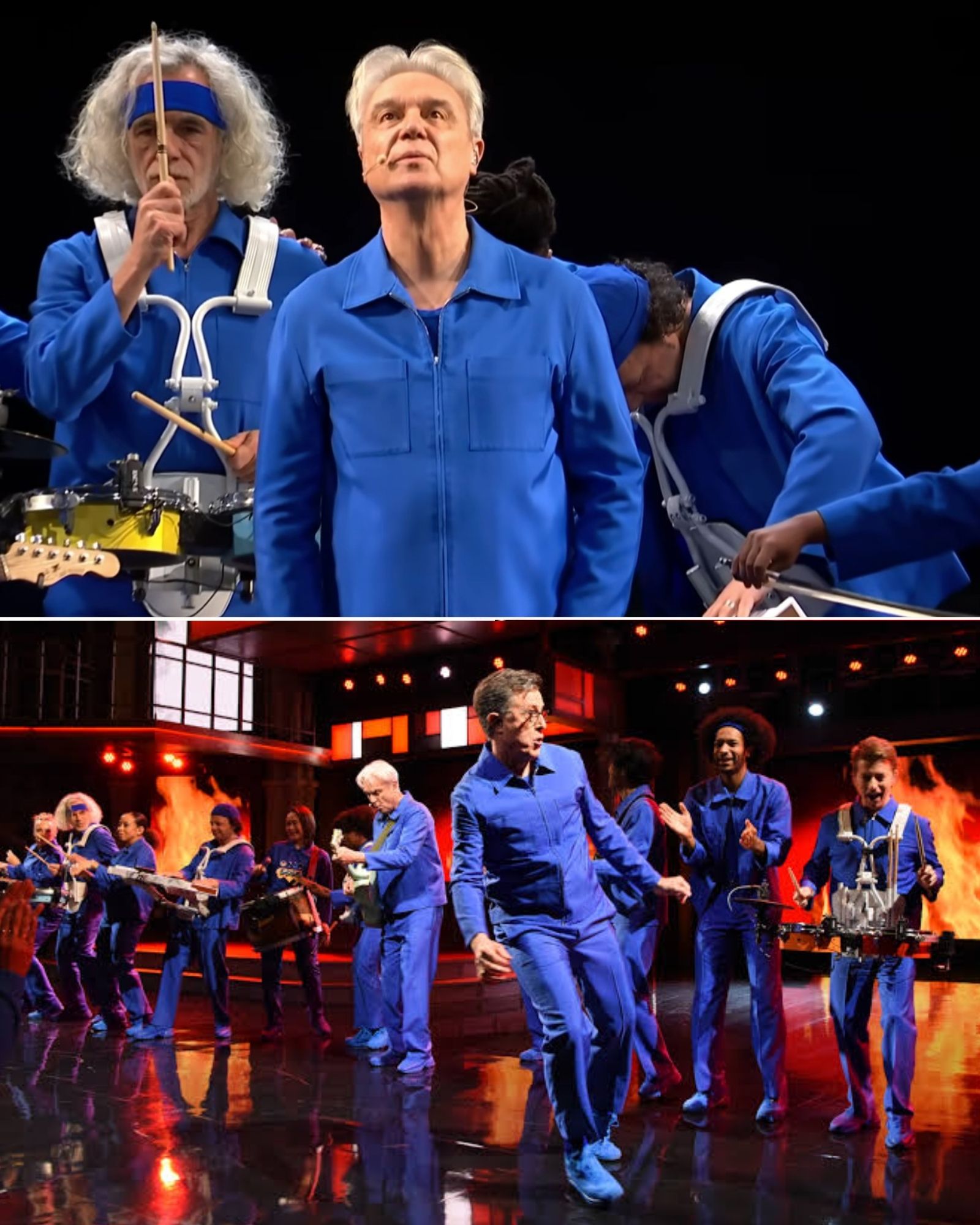
Tuesday night on The Late Show felt less like a regular television appearance and more like a last burst of electricity before the lights go out. David Byrne walked onto the stage with his band, all dressed in blue jumpsuits, all moving with the strange precision that has always made Byrne feel timeless. Wireless instruments meant no cords, no clutter, no barriers. Just sound, motion, and the kind of energy that can still make a room feel young.
Then came the song. “Burning Down the House” is 43 years old, yet it still hits with the force of something immediate and alive. On Tuesday night, it did exactly that. The Ed Sullivan Theater seemed to shake under the weight of it, as if the room itself remembered every version of the song it had ever heard and decided this one mattered most.
But the performance was not only about David Byrne. Near the end, when the band was already in full stride and the moment had fully taken over the room, Stephen Colbert appeared from nowhere. No big introduction. No long setup. Just Stephen Colbert in a blue suit, matching the band, stepping into the song as if he had been waiting for the right second to join the party.
He did not sing. He did not try to steal the spotlight. Stephen Colbert simply danced.
It was the kind of dancing that is not really about choreography at all. It is about instinct, gratitude, and the awareness that something important is slipping through your fingers. With only three episodes left in The Late Show‘s run, Stephen Colbert was not showing up for a cheap surprise. He was showing up like a host who understood the emotional math of the moment. After nearly 11 years and more than 1,600 episodes, a little dignity, a little mischief, and a lot of movement felt exactly right.
Some goodbyes are quiet. Others arrive with bass, blue fabric, and a dance step that says, we are not leaving without one more spark.
That is what made the performance land so deeply. It was funny, yes. It was theatrical, absolutely. But beneath the spectacle was something more honest: the recognition that endings do not have to be solemn to be real. Sometimes the most fitting farewell is not a speech. Sometimes it is a collision of memory, music, and a host in a blue suit refusing to sit still.
David Byrne, now 73, seemed to understand that immediately. He smiled and let Stephen Colbert into the moment without hesitation, as if to say that the song had always belonged to movement, to surprise, to anybody willing to step into the rhythm. Byrne has spent decades making art that feels slightly outside of time, and on Tuesday night he reminded everyone why. He still moves like time is negotiable.
Stephen Colbert’s final episode airs tomorrow night, and that alone would make this week feel heavy. Long-running shows create a strange kind of intimacy. They become part of the background of people’s lives until the background suddenly begins to disappear. But this performance did something rare: it turned an ending into a celebration without pretending the ending was not there.
Why This Moment Hit So Hard
Part of the power came from contrast. David Byrne’s performance carried the cool precision of a legendary artist who knows exactly who he is. Stephen Colbert’s entrance brought warmth, humor, and a little bit of chaos. Together, they created a feeling that was bigger than nostalgia. It felt like television remembering how to be joyful in public.
And perhaps that is why viewers responded so strongly. In an era when so many goodbyes are filtered through polished statements and carefully chosen words, this one arrived as movement. No one needed to explain what it meant. You could see it in the blue suit, in the smile, in the way Stephen Colbert danced like a man determined to give the ending one last pulse.
There was sadness there, of course. Anyone who has spent years with The Late Showknows that the final stretch is bittersweet. But the stronger emotion was gratitude. Gratitude for the show, for the music, for the shared experience of watching something end in a way that felt human instead of mechanical.
A Goodbye That Refused to Whisper
If this was the beginning of the end, then it was a spectacular one. Not because it tried to outrun the sadness, but because it honored it with energy. Stephen Colbert did not need to say goodbye directly. He let the dance do it for him.
And David Byrne, in his own unmistakable way, made room for the final flourish. That may be the most touching part of all. The moment felt spontaneous, but it also felt deeply earned. Two artists meeting at the edge of a closing chapter, both understanding that some nights deserve to be remembered not for what is ending, but for how fiercely it was celebrated.
When the final episode airs tomorrow night, it will be the official goodbye. But Tuesday night may already be the moment people carry with them. A song. A blue suit. A theater shaking with sound. And one man who decided that if the end was coming, it would not come quietly.
UDHËTO LIRË.
UDHËTO KOMOD.
Rezervo online shpejt, lehtë dhe pa stres.