The Artemis II crew has safely returned to Earth after completing a historic lunar flyby mission, but newly surfaced footage showing astronauts struggling to walk shortly after landing has sparked global attention and renewed focus on the physical toll of deep space travel.
Following a flawless “bullseye” splashdown in the Pacific Ocean off the coast of San Diego, the four astronauts—Reid Wiseman, Victor Glover, Christina Koch, and Jeremy Hansen—were recovered from their Orion spacecraft and transferred onto a U.S. Navy vessel for initial medical checks and post-mission procedures.
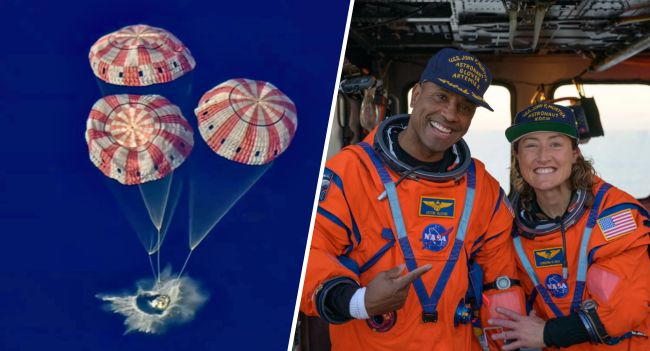
A TEXTBOOK RETURN AFTER A HISTORIC LUNAR MISSION
The mission itself marked a major milestone for NASA, successfully sending humans farther than any spacecraft has traveled since Apollo 17. The Orion capsule re-entered Earth’s atmosphere at extreme speeds exceeding 25,000 mph, enduring intense heat and a brief communications blackout before deploying parachutes and landing precisely as planned.
NASA officials later described the landing as a “perfect bullseye,” emphasizing the success of the spacecraft’s heat shield, navigation systems, and recovery operations.
STRUGGLING TO WALK AFTER RETURNING TO GRAVITY

However, what happened moments after recovery quickly became a focal point of public fascination.
Video footage from the recovery vessel shows the astronauts requiring assistance as they adjusted to Earth’s gravity after spending days in microgravity conditions. Each crew member was supported by medical staff while moving across the deck, with careful monitoring as their bodies readjusted to weight after an extended period in space.

NASA confirmed that such reactions are expected and temporary, explaining that even short-duration missions can temporarily affect balance, coordination, and muscle response.
WHY SPACE TRAVEL AFFECTS THE HUMAN BODY
Experts note that exposure to microgravity causes rapid physiological changes, even during relatively brief missions. These include fluid redistribution, muscle deconditioning, and inner-ear balance disruption, all of which can make standing and walking difficult immediately after return.
Although the Artemis II mission lasted only around 10 days, it was conducted in deep space beyond low Earth orbit, intensifying the effects compared to standard orbital missions.

NASA has long prepared astronauts for this phase of recovery, using post-landing mobility tests and rehabilitation protocols to help them gradually readjust to Earth’s gravity.
A SUCCESSFUL MISSION WITH HUMAN LIMITATIONS ON DISPLAY
Despite the dramatic visuals, NASA officials emphasized that all four astronauts were in excellent condition following landing and were cleared for standard recovery procedures.
The crew’s post-landing appearance, however, served as a powerful reminder that space exploration is not only a technological challenge, but also a profound physiological test for the human body.
THE NEXT PHASE OF LUNAR EXPLORATION
Artemis II is widely viewed as a critical stepping stone toward future lunar landings and the development of long-term human presence on the Moon under NASA’s Artemis program.
As attention now shifts toward Artemis III and beyond, scientists continue studying data from the mission to better understand how astronauts can be protected during longer and more complex journeys.
A MOMENT THAT REDEFINED HUMAN SPACE EXPLORATION
While the mission will be remembered for its precision landing and record-breaking lunar distance, it is the images of astronauts regaining their footing on Earth that have captured global attention—highlighting both the triumph and vulnerability of human spaceflight.
And according to one NASA medical specialist involved in the recovery operation, the most revealing insights may still be coming—because early physiological data from the crew reportedly includes unexpected responses that researchers say could “reshape how future deep-space missions are planned”…
UDHËTO LIRË.
UDHËTO KOMOD.
Rezervo online shpejt, lehtë dhe pa stres.