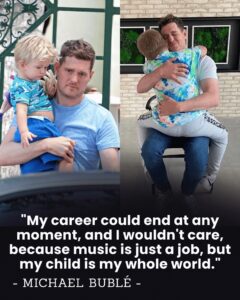
“My career could end at any moment, and I wouldn’t care, because music is just a job—but my children are my whole world.” When Michael Bublé said these words, they were not a philosophical reflection. They were a vow forged in terror. In 2016, at the height of global success, Bublé made a decision almost unheard of in modern entertainment: he stepped away from everything—awards, tours, contracts, and public life—because none of it mattered anymore.
The rupture came suddenly. In November 2016, just before a scheduled performance in London, Bublé received a message from his wife, Luisana Lopilato. Their eldest son, Noah, only three years old, had been diagnosed with hepatoblastoma, a rare and aggressive form of liver cancer. In an instant, the world split in two—before and after. The Grammys, platinum records, and sold-out arenas became irrelevant artifacts from a life that no longer existed.
Bublé canceled everything without hesitation. He withdrew from hosting duties, album plans, and public appearances, disappearing almost entirely from the spotlight. For seven months, he lived not as a global star, but as a father beside a hospital bed, accompanying Noah through chemotherapy and surgery. Hollywood’s glamour was replaced by fluorescent lights, fear, and relentless uncertainty.
During that period, Bublé later admitted, something inside him collapsed—and something clearer emerged. Before the diagnosis, he said, he had become obsessed with performance, relevance, and legacy. The illness stripped away that illusion. Music, he realized, was meaningful—but it was not sacred. Family was.
To survive emotionally, Bublé drew inspiration from Life Is Beautiful, directed by Roberto Benigni. Like the father in the film who shields his son from horror through imagination, Bublé transformed the hospital into a place of play—building tents from bedsheets, turning fear into games—anything to protect Noah’s spirit.
When Noah entered remission in 2017, the man who returned was not the same performer who had left. Bublé went back into the studio with producer David Foster, not to chase hits, but to express gratitude. The result was the album Love, shaped by humility rather than ambition.
One song, Forever Now, written for his children, remains too painful for him to perform live. He has said it breaks him every time—a reminder of how close he came to losing everything that mattered.
Today, raising Noah alongside his other children, Elias, Vida, and Cielo, Michael Bublé stands as a quiet contradiction to celebrity culture. He proved that the greatest freedom is knowing when to walk away—and that in the face of life and death, fame is just noise, but love is everything.
UDHËTO LIRË.
UDHËTO KOMOD.
Rezervo online shpejt, lehtë dhe pa stres.